


One of my favorite yoga cues, and also the most common to every yoga or mindfulness practice, is “Inhale, and exhale”. On a purely physiological level, this is a simple mechanical cue. It is an instruction to contract and relax the diaphragm, drawing oxygen in and expelling carbon dioxide. However, the opposing prefixes in- and ex- always make me picture my body as a pristine container. As the breath flows in and out, smoothly and freely, I visualize an air cleaner at work. With every inhalation, fresh energy drawn from the room enters the system; with every exhalation, the heavy, stagnant pollutants of the day, stress, deadlines, mental static, are filtered out and expelled. Within the rhythm of that cycle, I become noticeably calmer.
Physiologically, of course, I am not a plastic appliance with a HEPA filter. My lungs do not possess carbon cartridges, and my throat is not a ventilation duct. Yet, the moment I adopt that image, and the abstract concept of “finding calm” becomes a tangible, achievable physical reality. How is this association possible? How can a modern mechanical apparatus explain the ancient, internal mystery of human respiration? The answer lies in the most powerful, misunderstood tool in human consciousness: metaphor.
We are taught in school that metaphors are decorative ornaments, the “flowery language” reserved for poets, novelists, and romantic speechmakers. We are led to believe that a metaphor is merely an aesthetic choice, a way to dress up literal facts to make them sound prettier.
This view is fundamentally incomplete. Rather than being merely as a literary device; metaphor is a cognitive instinct. It is the primary framework through which the human brain processes abstract reality, communicates complex emotions, and builds shared understanding. Without it, our communication would be reduced to flat, functional data transmission. With it, we can bridge the massive gap between the physical world we inhabit and the internal world we experience.
The Cognitive Architecture: Source and Target Domains
To understand why the “air cleaner” image works so effectively on a yoga mat, we have to look at how the brain processes information. In the 1980s, linguist George Lakoff and philosopher Mark Johnson revolutionized the study of linguistics by introducing Conceptual Metaphor Theory. They argued that our conceptual system, the way we think and act, is fundamentally metaphorical in nature.
At its core, a metaphor functions as a cognitive bridge between two distinct realms:
1. The Source Domain: The concrete, physical, or highly familiar concept we already understand through our direct experience with the physical world (e.g., an air cleaner, a heavy weight, a smooth path).
2. The Target Domain: The abstract, complex, or subjective concept we are trying to comprehend or communicate (e.g., peace of mind, emotional burdens, a career trajectory).
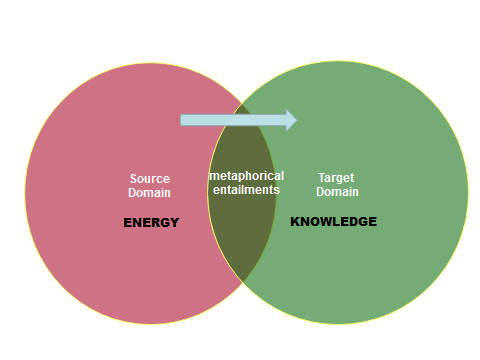
When I view my breathing through the lens of a filter, my brain is performing a conceptual mapping. It takes what it knows about a physical object, that it takes in dirty air, traps the impurities, and releases clean air, and projects those structural rules onto my emotional state.
Human beings are physical creatures trapped in an abstract world. We have bodies that feel gravity, temperature, and collision, but we navigate lives governed by unseen concepts like inflation, love, trauma, and digital networks. Because we cannot touch “anxiety” or see “justice”, our brains instinctively reach into our physical surroundings to find something familiar that behaves in a similar way. We use metaphors far beyond mere to describe things but rely on them to actively generate meaning. The metaphor doesn’t come after the thought; the metaphor is the thought.
The Trap of the Literal: Why Flat Language Fails
To truly appreciate the power of figurative expression, imagine a world stripped entirely of it. Imagine a purely literal language, one where every word must correspond exactly and directly to a physical fact.
If my yoga instructor were forced to speak only in literal terms, the cue would sound like this: “Contract your diaphragm to create negative pressure in your thoracic cavity, allowing atmospheric gases to enter your lungs, then relax the muscle to expel carbon dioxide”. While scientifically accurate, this description is less evocative as a guide to mindfulness. It addresses the mechanics of the machine, but it completely misses the experience of the driver. Literal language is a precision instrument for data, but it is a clumsy, blunt instrument for human connection.
When we communicate, we are rarely just trying to transfer facts. We are trying to transfer resonance. If a friend tells you, “I feel bad because I have a lot of work to do”, you understand the data point. But if they say, “I feel like I’m drowning, and the water is rising every hour”, the communication enters a different dimension.
Literal language tells us what a thing is. Figurative language tells us what a thing feels like. The “drowning” metaphor instantly activates your own physical memories of being out of breath, submerged, or helpless. By mapping their work trouble onto the physical experience of deep water, your friend has bypassed your intellectual processing and spoken directly to your empathetic center. Metaphor is the ultimate shortcut in human communication: it compresses massive amounts of emotional and contextual data into a single, visceral image.
How Metaphors Quietly Frame Our Reality
The danger and the beauty of metaphors is that they are often invisible. We use them so frequently that they become part of the linguistic background noise, shaping our beliefs and behaviors without our conscious consent. These are known as structural metaphors, and they govern entire sectors of public and private life.
Consider how we talk about everyday interactions. The most famous example from Lakoff and Johnson’s work is the conceptual metaphor: Argument is War.
Look at the vocabulary we use whenever two people disagree:
· He attacked every weak point in my thesis.
· Her criticisms were right on target.
· I demolished his position.
· If you use that strategy, she will wipe the floor with you.
· He defended his line of reasoning.
Because we map the source domain of “War” onto the target domain of “Argument”, we treat the person across from us as an adversary. The goal of the conversation becomes winning, territory control, and destruction.
But what if we changed the metaphor? What if our cultural framework was Argument is a Dance?
If we viewed a disagreement as a dance, the vocabulary would shift entirely:
· They balanced each other’s points beautifully.
· Her counter-argument complemented his opening movement.
· They worked together to find a rhythm.
The physical reality of the interaction would remain exactly the same, two people sitting in a room talking about a disagreement, but the psychological reality would be transformed. We would view the participant not as an enemy to be crushed, but as a partner helping us construct a beautiful, balanced performance.
This is the hidden power of figurative expression in communication: whoever controls the metaphor controls the narrative. When public figures choose their metaphors, instead of just selecting words, they are choosing the policies, solutions, and moral frameworks that their audience will accept.
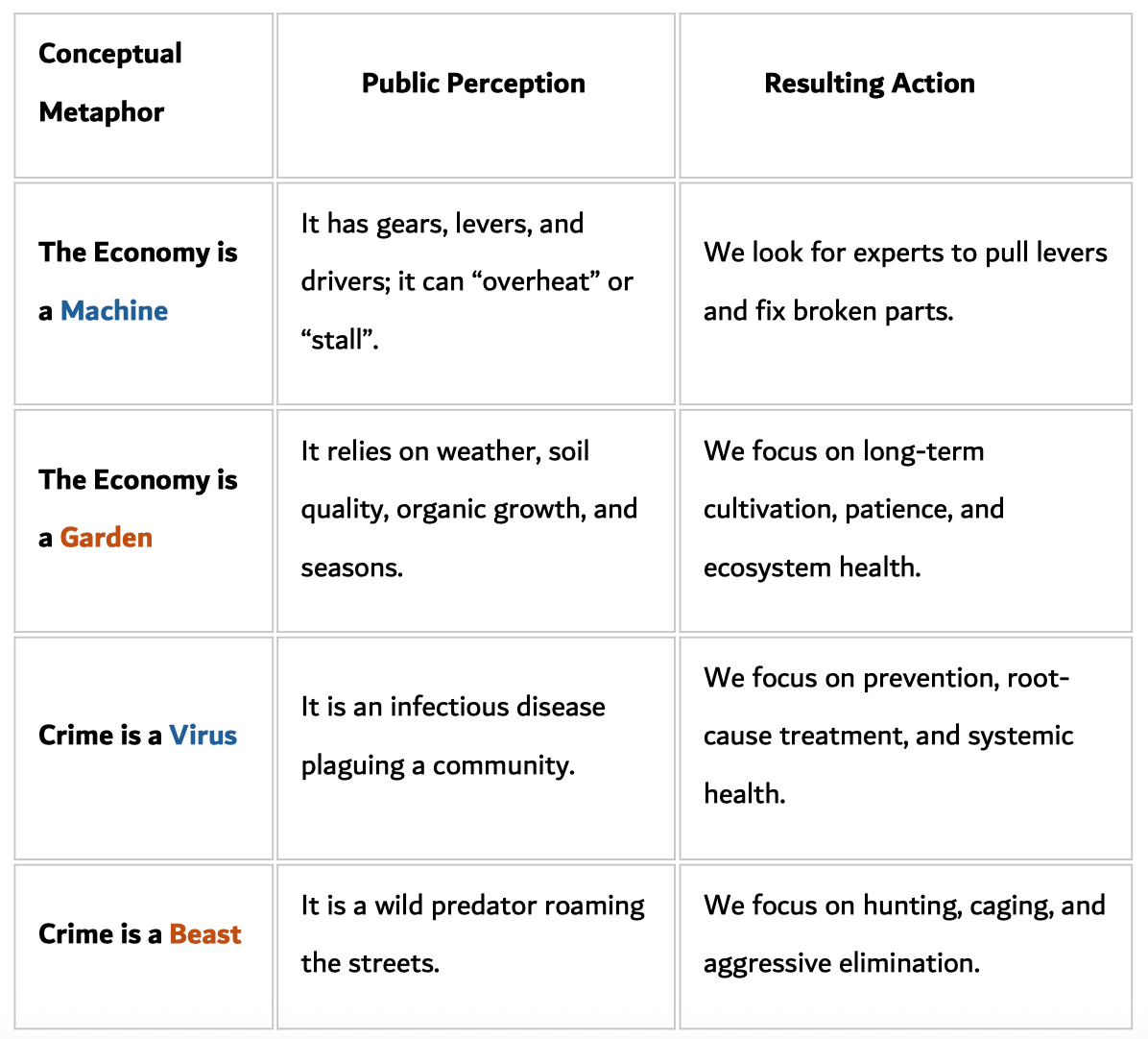
The Three Pillars of Metaphorical Thought
So far, we have seen that metaphors are cognitive tools that allow us to construct meaning from abstract experience. To refine this cognitive mechanism further, Conceptual Metaphor Theory identifies three distinct classifications of this mapping process: Structural, Orientational, and Ontological. Each plays a unique role in how we construct our mental models of reality.
The previous section has already introduced structural metaphors, the most familiar and extensively studied category. In a structural metaphor, one complex concept is understood through the structure of another well-established concept. Rather than borrowing a few descriptive features, the mind maps the internal logic of the source domain onto the target domain, allowing us to reason, plan, and act in ways that mirror our understanding of the source. Expressions such as Argument is War or Time is Money illustrate how entire systems of thought are organized through this kind of conceptual mapping.
A second category is the orientational metaphor. Instead of mapping one concept onto another object or system, orientational metaphors organize experience through spatial relationships such as up/down, in/out, front/back, and deep/shallow. These spatial orientations arise from our embodied existence: we live in a world shaped by gravity, bodily movement, and physical direction. As a result, abstract concepts inherit these spatial patterns. Positive emotions are commonly associated with upward movement (“My spirits soared”), while negative emotions are associated with downward movement (“I’m feeling down”). Likewise, we often conceptualize rationality as higher than emotion or instinct. Orientational metaphors therefore provide abstract experience with an immediate emotional or evaluative direction grounded in bodily perception.
The third category is the ontological metaphor, perhaps the most fundamental of all. Ontological metaphors allow us to understand abstract experiences by treating them as physical objects, substances, containers, or even living entities. Emotions, ideas, memories, and social phenomena possess no tangible boundaries, yet our minds instinctively assign them shape, location, and substance. We speak of getting an idea out of our heads, filling our minds with information, or combating inflation because these abstract concepts have been cognitively transformed into objects that can be contained, manipulated, or acted upon. By objectifying the intangible, ontological metaphors make abstract thought cognitively manageable.
Seen through this framework, when a practitioner visualizes a yoga cue “inhale and exhale” as a mechanism to clear the mind, it activates multiple interacting conceptual metaphors. At the orientational level, inhalation and exhalation instantiate the spatial opposition between inside and outside. At the ontological level, abstract mental states such as anxiety and stress are conceptualized as tangible substances that can be contained and displaced. At the same time, the body itself becomes a container capable of holding or releasing these substances, while the act of breathing is understood through the structural metaphor of an air filtration system. Each inhalation draws in fresh, clean energy, and each exhalation removes accumulated mental pollutants. Through this layered conceptual mapping, an invisible psychological process is transformed into a concrete physical procedure that the mind can readily imagine and enact. What
begins as a breathing exercise therefore becomes a cognitively coherent model for emotional regulation.
The Anatomy of a Brilliant Metaphor
Once we move beyond the rigid boundary of schoolhouse rhetoric and broaden our understanding to recognize metaphors as engine of communication, how do we use them effectively? If our daily communication is deeply embedded in these cognitive mappings, how do we transcend clichés and create figurative expressions that truly transform the audience’s perspective? A brilliant metaphor requires three essential elements: visceral familiarity, structural alignment, and calculated restraint.
1. Visceral Familiarity (The Physical Grounding)
A metaphor fails if the source domain is just as confusing or abstract as the target domain. The best metaphors draw from universal human experiences: weight, light, movement, cleanliness, heat, and cold. When I use the “air purifier” metaphor for yoga, it works because everyone in the modern world knows the quiet, steady, rhythmic sound of a fan cleansing an indoor space. It immediately evokes a sensation of crispness and clarity.
2. Structural Alignment (The Truthful Fit)
The mapping must make logical sense to the brain. If you say, “My mind is a bicycle tire popping under the pressure of work”, the image works structurally because pressure causes things to rupture. If you say, “My mind is a library book melting under the pressure of work”, the connection breaks down. Books don’t melt under physical pressure; the mapping collapses, and the reader is left distracted by the logical error rather than moved by the emotion.
3. Calculated Restraint (Avoiding the Cliché)
The greatest enemy of effective communication is the dead metaphor, an image that was once fresh and vivid but has been used so many times that its sensory force has faded. Expressions such as “at the end of the day”, “thinking outside the box”, or “a roller coaster of emotions” are not poor metaphors in themselves. The repeated exposure changes how we process them. They no longer picture the sun setting, a physical box waiting to be climbed out of, or the twists and drops of an amusement park ride. The underlying conceptual mapping still exists, but the reader’s cognitive mapping engine simply refuses to fire. To make a metaphor alive, you must revive its physical reality. If you must talk about a roller coaster, make the reader feel the cold metal bar clicking against their stomach, the sudden drop in their intestines, and the whiplash of the turn. Better yet, find a new image entirely.
Crafting Your Own Figurative Language: A Writer’s Guide
For writers, creators, and leaders, mastering the art of the metaphor is the difference between being understood and being remembered. Here is a practical blueprint for integrating powerful figurative expressions into your own work.
Step A: Isolate the Abstract Emotion or Concept
Before you write, determine the exact target domain you want your audience to feel. Do not settle for vague terms like “stressed” or “happy”. Pinpoint the specific texture of the feeling. Is it a chaotic, noisy stress? Or is it a heavy, paralyzed stress?
Step B: Identify a Corresponding Physical Sensation
Look around the physical world for objects, systems, or environments that replicate that exact texture.
· If the stress is chaotic and noisy, your mind might be an open browser with fifty tabs playing audio simultaneously.
· If the stress is heavy and paralyzed, your mind might be wet cement quickly hardening around your ankles.
Step C: Execute the Shift (The “Salt” Rule)
Introduce the metaphor smoothly, use it to anchor your paragraph, and then step back. Do not over-extend it. If you are using the browser tab metaphor, don’t spend three pages discussing RAM upgrades, internet service providers, and pop-up blockers. Use the image to lock in the emotional truth, then return to your narrative.
As mentioned before, think of metaphor as salt: a pinch brings out the natural flavor of the dish, but dump the whole shaker in, and it becomes completely unpalatable.
Conclusion: The Breath Inside the Word
We live in an era that worships data, analytics, and literal transparency. We are flooded with metrics, dashboards, clear-cut bullet points, and optimized copy. Yet, despite this massive influx of raw information, we often feel more disconnected, misunderstood, and isolated than ever before. This disconnect happens because literal information alone rarely creates understanding. Though facts can be transmitted with remarkable efficiency, shared experience requires something more. To truly communicate with another human being is to perform a small miracle: to take an invisible, subjective experience inside your own soul and place it accurately inside the soul of another. That is why we need images, physical analogies and metaphors.
Of course, metaphors are never universal. Their effectiveness is deeply bound to context, such as real-time interaction, cultural variation, and the shared knowledge that speakers bring to a conversation. A metaphor that resonates deeply within one community may puzzle another, while expressions that function as technical jargon within a profession may seem opaque to outsiders. Yet this context dependence is not a weakness. It is precisely because metaphors draw upon specific, shared experiences that they possess such communicative power. When writers provide the right context, they give readers a custom-built conceptual bridge needed to cross from unfamiliar ideas to intuitive understanding. The next time you struggle to explain an idea, present a proposal, or express an overwhelming emotion, try to resist the instinct to rely solely on literal definitions. Instead, ask yourself what embodied experience your audience already understands.
Perhaps that is why a simple cue from the yoga mat “inhale and exhale” can carry so much meaning. It creates the perfect context for my own mind. With every single inhalation, I don’t just feel oxygen entering my lungs; I feel my entire physical and emotional system being purified. The key to this profound experience lies entirely in the fact that it activates my cognitive mapping through metaphor.
Metaphor is not merely decoration added to language after thought has already taken shape. It is one of the fundamental cognitive tools through which thought itself becomes communicable. It is the architecture beneath our words, the bridge between minds, and perhaps the closest thing we have to breathing life into language.


